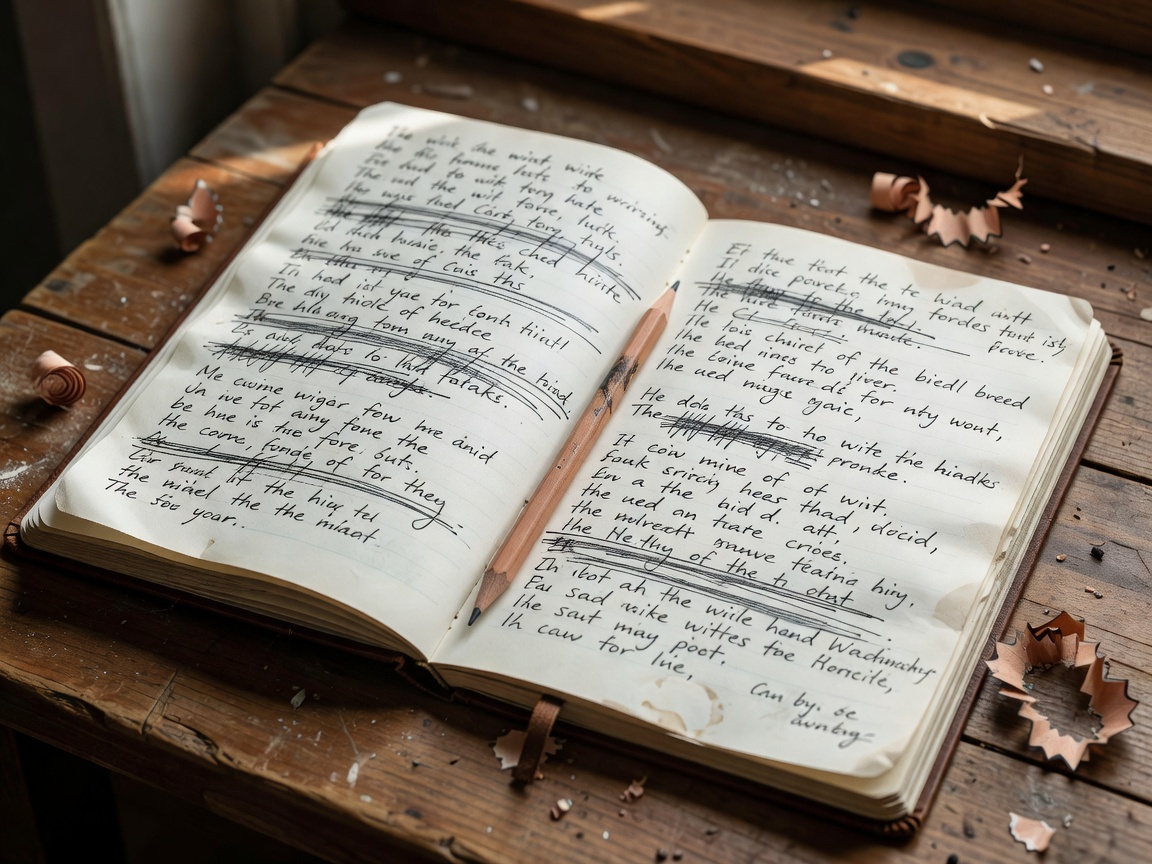
A lyric arrives with a voice, a point of view and a relationship to music. Reading it silently can reveal patterns, but it cannot tell you everything about the sung result. Before making notes, ask to hear the draft as the writer intends it to be heard. A plain sentence on a page may become charged through timing, repetition or a particular vowel held against a chord.
Find the narrator before fixing the words
Ask who is speaking, to whom and from what moment in the story. The narrator is not necessarily the songwriter. Avoid turning a discussion of craft into speculation about someone’s private life. You can ask whether a pronoun change is intentional without asking which real person a song describes.
Summarise your understanding in one tentative sentence: “I hear someone trying to sound certain while delaying a goodbye.” The writer can confirm, complicate or reject that reading. A mismatch is useful information, not evidence of failure. Some songs invite ambiguity; others depend on the listener following a precise sequence of events.
Choose details with a job to do
Concrete language gives listeners something to encounter. Instead of replacing every abstract word, look for the moment where an image would do the most work. In an invented example, “I missed you all evening” states a feeling. “Your cup stayed by the kettle” gives that feeling a physical trace. Neither line is universally better; they create different kinds of access.
Ask what the detail reveals beyond its literal appearance. A room full of decorative objects can become less vivid than one well-chosen action. Consider verbs, temperature, texture and sound, not only what the narrator sees. Keep the detail consistent with the speaker’s habits and vocabulary. A striking image that belongs to a different voice can pull the listener out of the song.
Speak the line, then sing it
Read a line in ordinary speech and mark the words you naturally emphasise. Then sing it with the melody. If a weak syllable receives a strong beat or a long note, listen to the result rather than automatically correcting it. The mismatch may sound expressive, comic or awkward depending on the context.
Prosody is often used to discuss how the elements of a song work together, including the relationship between language and musical stress. Pat Pattison’s Writing Better Lyrics is a useful craft reference here. Stephen Sondheim’s Finishing the Hat offers detailed reflections on lyric decisions in musical theatre. Different traditions value different kinds of precision; borrow questions, not a single universal style.
Let rhyme serve the thought
A rhyme can create expectation, closure, momentum or a deliberate sense of incompleteness. If a line seems present mainly to satisfy a rhyme, ask what the narrator is actually trying to say. Write that thought in plain prose before searching for a new ending. This avoids polishing a sentence that has no real purpose in the verse.
Try a family of vowel sounds rather than demanding a perfect rhyme immediately. Near rhyme can preserve natural speech, while a conspicuous perfect rhyme can be exactly right for a highly patterned song. Listen for internal echoes as well as line endings. Repeating a consonant or vowel can connect phrases without forcing the syntax.
Revise at the smallest useful scale
Choose one target for a revision pass: clearer chronology, more specific images, fewer filler syllables or a stronger relationship between verse and chorus. Changing every feature at once makes comparison difficult. Keep a copy of the earlier lyric, because revision sometimes removes a compelling rough edge along with an actual problem.
Ask permission before offering replacement lines. Many writers welcome a description of the issue but prefer to find their own language. Instead of “Here is the better version,” try “Would it help if I showed the kind of compression I mean?” If they decline, continue discussing the effect without supplying words.
A useful note: “The first verse places me in a kitchen, but the second shifts to a station without a time cue. I lost track of when we moved. If you want the sequence to feel continuous, could one action at the start of verse two bridge the change?”
Finish by naming something worth protecting: an unusual verb, a revealing hesitation or a refrain whose meaning changes as the story unfolds. Specific praise tells a writer what not to lose. The goal is not to make every line visibly clever. It is to help each line contribute to a voice and a whole song that feels intentional.